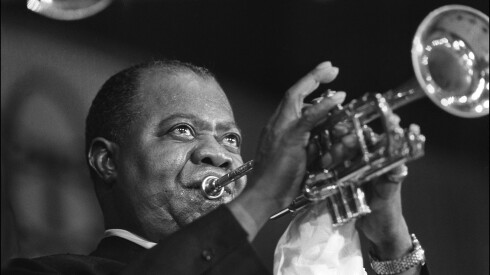
As of this week, Louis Armstrong’s music has traveled further than anything else in human history.
On Wednesday morning, the interstellar probe Voyager 1 reached one light-day away from Earth, or the distance it takes light to travel in one day. On board is a golden record containing sights and sounds from our humble planet. Among them: a 1927 recording of Armstrong, playing with the Hot Seven band he founded in Chicago.
But Armstrong left us plenty of surprises here on Earth. Last week, Verve Records released a never-before-heard bootleg of the iconic trumpeter and singer performing with his All Stars Band at — of all places — a high school auditorium in Highland Park.
The concert was a fundraiser for a local synagogue, which was renamed B’nai Torah shortly after the concert. It closed permanently in 2014.
The Highland Park concert would not survive — much less in such a high-quality recording — were it not for Joel Goldstein, an 87-year-old resident of Laguna Woods, Calif., who provided the tape to the Louis Armstrong House Museum in Queens, New York. At the time of the recording, Goldstein was a 17-year-old student stage manager at Highland Park High School, where a 1,200-seat auditorium hosted the benefit concert.
Goldstein and his friend Ron Johnson, another student in charge of audio, decided to record the concert using the auditorium’s state-of-the-art sound equipment. After all, it wasn’t every day Louis Armstrong came to your high school.
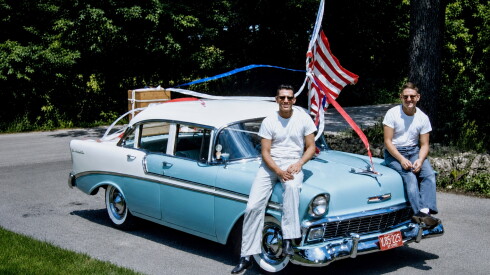
Joel Goldstein (left) and his classmate Ron Johnson, pictured here on July 4, 1957, were students in charge of audio during a Louis Armstrong concert that spring at Highland Park High. Goldstein decided to record the concert using the auditorium’s state-of-the-art sound equipment and kept the bootleg for decades.
Courtesy of Joel Goldstein
“I don't think anybody besides myself and my immediate family had any awareness that we had done this, because I didn't want to go to jail,” Goldstein remembers, with a chuckle.
After graduating from Highland Park High School, Goldstein briefly attended Purdue University before transferring to Grinnell College, in Iowa. There, he was classmates with jazz icon and fellow Chicagoan Herbie Hancock, who lived in the same residence hall.
“Everybody knew he was gifted,” Goldstein says of Hancock, who would, just a few short years after college, become the pianist in Miles Davis’s legendary Second Great Quintet.
Decades later, when Goldstein contacted the Louis Armstrong House Museum and told research director Ricky Riccardi about the recording, Riccardi wasn’t all that shocked. Armstrong and his All Stars band frequently tacked community appearances to their tours, and this cause would have been important to him: Armstrong expressed a “long time admiration for the Jewish people,” owing to close friendships with a neighboring family in New Orleans and his manager, Joe Glaser. He wore at least two different Star of David pendants around his neck throughout his life.
What Riccardi didn’t expect was how exceptionally well-recorded the tape was, capturing an All Stars lineup that was “on fire”: trombonist Trummy Young, clarinetist Edmond Hall, pianist Billy Kyle, bassist Squire Gersh and drummer Barrett Deems, a Chicago fixture whose kit is still on display at Andy’s Jazz Club in River North. (Riccardi hails him as a “proto-punk rock drummer.”)
“This is the most exciting band I've ever heard,” Riccardi says. “And, you know, this is not Carnegie Hall; this is not the Newport Jazz Festival. It's just a stop in Highland Park on the way to the next one, [but they’re] still playing with that fire and energy.”
Armstrong’s own small-format band, the All Stars, marked a return to the combos of the trumpeter's influential early career in Chicago. The bands he played in here from 1922 to 1929 — King Oliver’s Creole Jazz Band, then his own Hot Five and Hot Seven — hugely influenced the development of early jazz.
By his All Stars era, however, critics felt Armstrong was a shadow of the pioneering trumpeter and bandleader he once was. Nor was the criticism purely musical. Activists were disappointed that Armstrong didn’t use his massive platform to speak out more forcefully about civil rights.
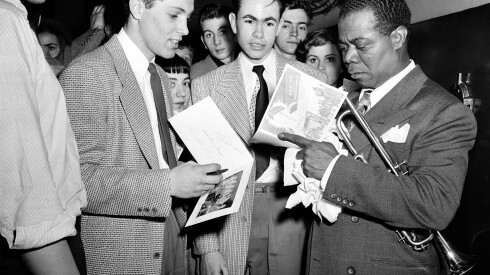
Armstrong, right, autographs a group picture made in the Blue Note nightclub during a jazz concert for teenagers in Chicago on April 1, 1948. Standing at left is Paul Meyer, 16, and at center is Tom Koch, 17, of Milwaukee, Wis., who hitch-hiked to Chicago to attend the afternoon concert.
Photo by Edward S. Kitch/AP Photo
The 1957 All Stars tour — the very sweep that included the Highland Park concert — marked a turning point. School desegregation in Little Rock, Ark., dominated the headlines, as did the fierce opposition by white residents and local authorities. The integrated All Stars faced their own vitriol on the road: Playing in Knoxville, Tenn., a month before the Highland Park concert, the group was mid-concert when the building trembled. The city’s White Citizens Council had lobbed dynamite at the venue from a moving car.
By the time he and the All Stars arrived in Fargo, N.D. in September — playing yet another school auditorium concert — Armstrong had reached his breaking point. He spoke candidly to a student journalist about the crisis in Little Rock, calling President Dwight D. Eisenhower “two-faced” and Arkansas governor Orval Faubus a name so vulgar it couldn’t be printed. (Armstrong and the journalist mutually settled on “uneducated plow boy” as a euphemism.)
Most consequently, Armstrong threatened to withdraw from a planned tour of the Soviet Union, one of several orchestrated by the State Department as a propaganda initiative during the Cold War. “The way they are treating my people in the South, the government can go to hell,” Armstrong said.
Riccardi feels Armstrong was just as underestimated musically during this period. His playing is nimble and energetic across the concert, which is full of All Stars signatures. The band opens its sets as it usually would, with the one-two punch of “When It’s Sleepy Time Down South” and “Indiana,” and closes with a swinging rendition of “When the Saints Go Marching In.” At the very end, Armstrong asks the audience to stand for “The Star-Spangled Banner,” a tribute to the country he loved enough to criticize.
“They're saying that he’s coasting and he's phoning it in,” Riccardi says. “If you think he was coasting, this concert will dispel all of that.”
As for the surreptitious recorder, Goldstein went on to work for federal agencies in Washington, D.C., like the National Institute of Mental Health and Substance Abuse and Mental Services Administration. After retiring, he and his wife moved to California in 2010. He carted around the audio all that time — first the original tape, then a copy he digitized in the 1980s.
In 2019, Goldstein saw a PBS segment on the Louis Armstrong House Museum’s expansion plans. By then, Johnson, the former audio manager, had passed away, and Goldstein wondered if the museum could benefit from a copy of the tape. He was shocked when Riccardi responded to his offer a week later, suggesting that the recording be turned into an album.
“I had never thought about a commercial release. My whole idea was to keep a low profile about what I'd done,” Goldstein says.
Now that he’s gone public, however, Goldstein looks back on the recording — and its new place in jazz history — with pride.
“I have four grandchildren, ages 12 to 21, and I asked each of them separately, ‘Have you ever heard of Louis Armstrong?’ And all four of them said immediately, ‘Oh yes, of course,’” Goldstein says. “He supersedes jazz.”